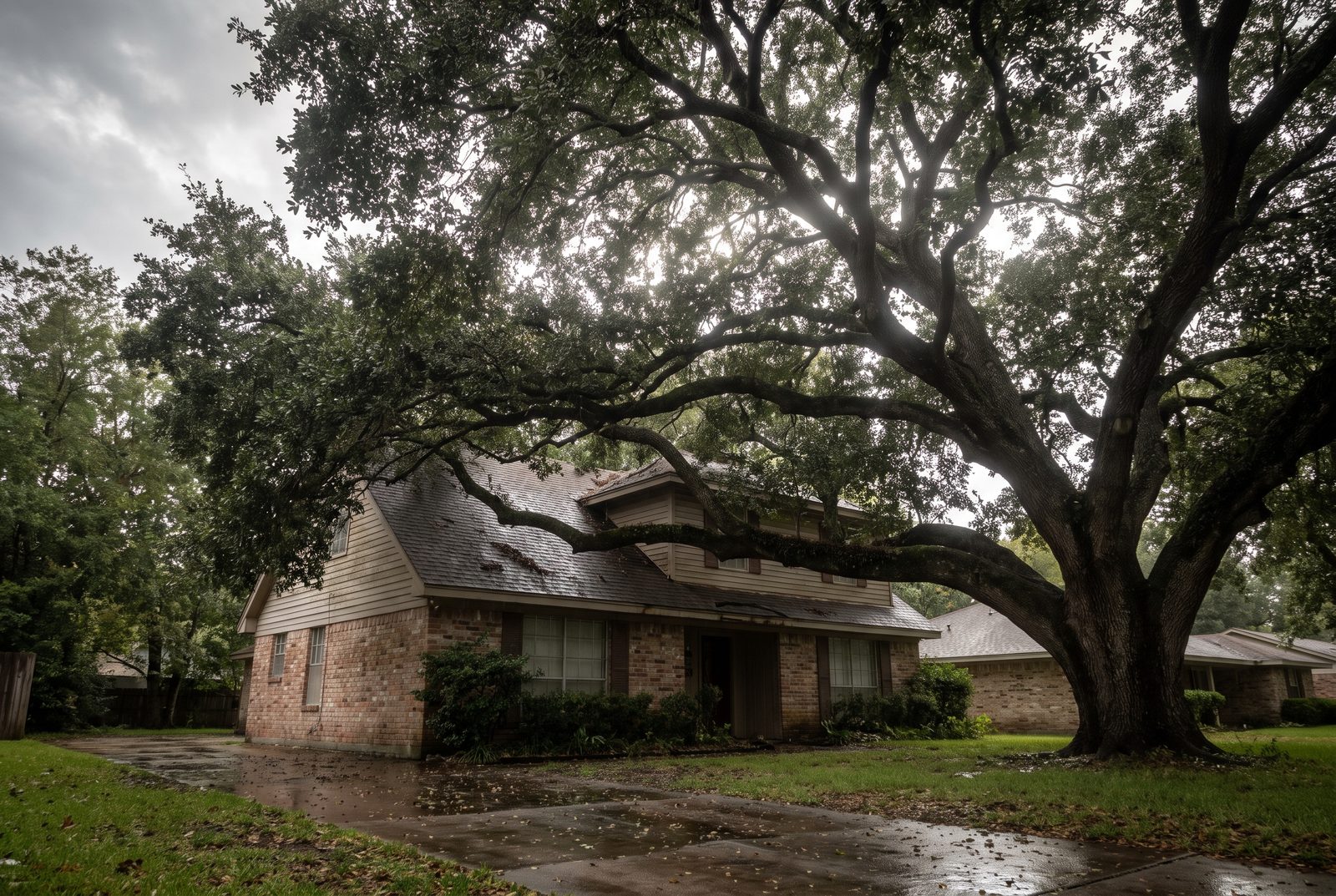
It has been there longer than the house has had its current owners. From the ground it reads as scenery. From the roofline it is several tons of leverage, and almost nobody has ever assessed it.
Ask a homeowner how big the tree in their front garden is and they will usually gesture vaguely upward. It is not evasion. A mature hardwood is genuinely difficult to perceive accurately from underneath it — the canopy foreshortens, the trunk reads as narrower than it is, and the limbs that extend over the roof are the hardest part of the whole structure to see from any position on the ground.
This matters because the decisions people make about trees are made almost entirely on appearance. A tree that looks healthy gets left alone. A tree that looks untidy gets trimmed. Neither judgement has much to do with whether the tree is structurally sound, and the gap between the two is where most preventable property damage lives.
Whole-tree failure does happen, usually where root systems have been compromised by construction, saturation or disease. But it is not the common case. The common case is a single large limb, frequently one that has been under load for years, letting go during a storm that a healthy limb would have ridden out.
The mechanisms are consistent and mostly invisible from below. Included bark — where two stems grow so closely that bark becomes trapped in the join — creates a union with a fraction of the strength it appears to have. Decay pockets hollow a limb from the inside while the outer wood and full leaf canopy suggest complete health. Codominant stems, two trunks of similar size competing from a single point, concentrate stress exactly where the tree is weakest. None of these are visible without getting up into the canopy and knowing what to look at.
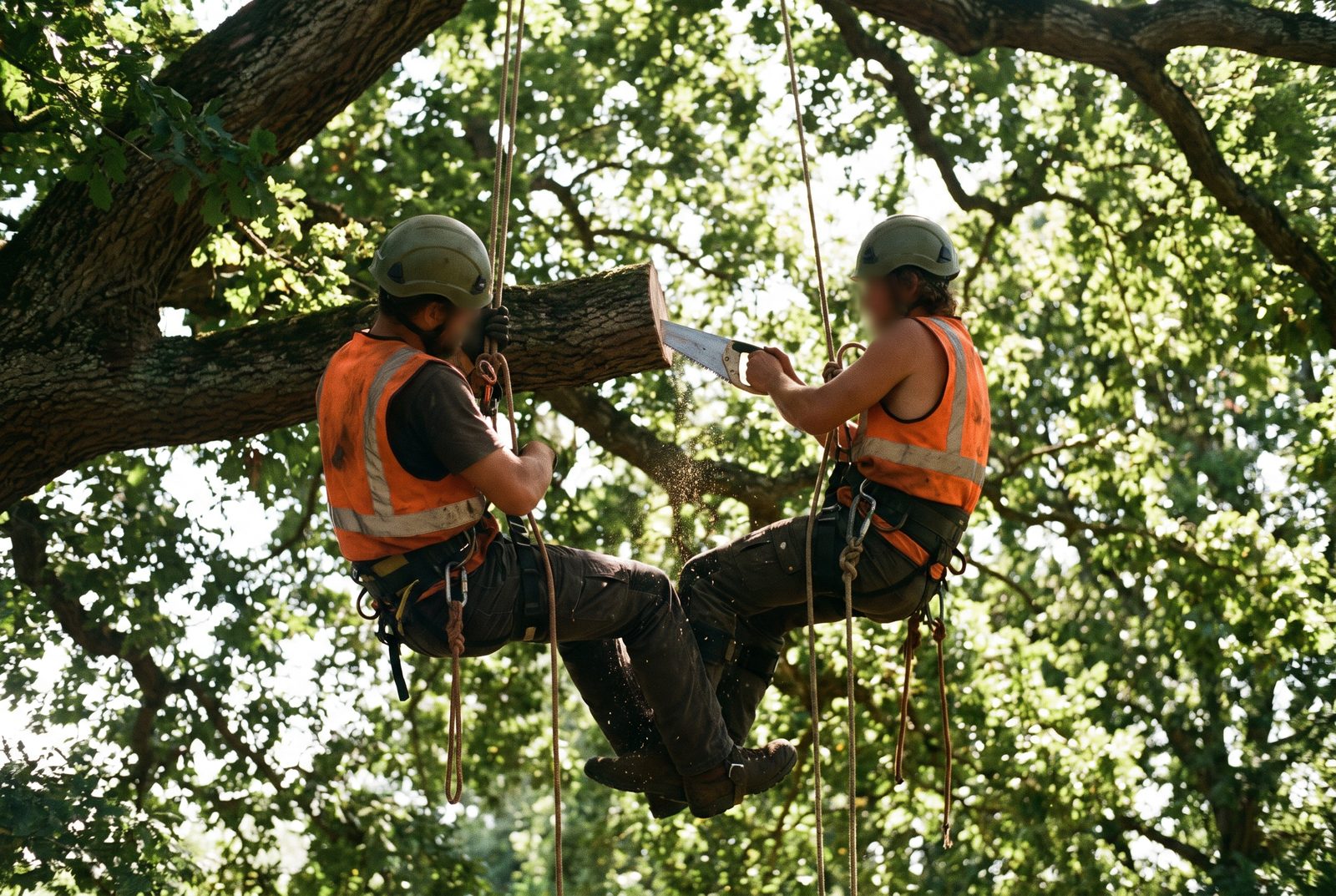
Tree work attracts casual operators for an obvious reason: the equipment barrier looks low. A chainsaw, a truck and a willingness to climb appear to be the whole business. They are not. The gap between an outfit like that and a professional crew is not skill with a saw. It is insurance, rigging competence, and knowing which cuts are survivable.
If an uninsured crew drops a limb through your roof, that is not their claim. It is yours.
This is the part homeowners routinely misunderstand. Liability does not automatically follow the person who caused the damage. An uninsured operator with no meaningful assets is, in practical terms, not a party you can recover from. The damage lands on your own policy, with your own deductible and your own claims history. The saving on the quote is dwarfed by that exposure on the first bad day.
Worse, if a worker is injured on your property and the company carries no workers' compensation cover, the exposure can extend to the homeowner. This is not a hypothetical peculiar to tree work — it is simply more likely here, because the work is genuinely dangerous and the barrier to entry is genuinely low.
A professional operation will produce all five without hesitation, because they have them to hand. Hesitation on any one of them is the answer to the question.
An arborist assessment is a diagnostic exercise, and its most common conclusion is that nothing needs to happen. That is a legitimate and useful outcome — it converts an open worry into a documented condition with a date on it.
A proper assessment examines the root flare and surrounding soil for movement, decay and prior damage; the trunk for cavities, cracks and fungal indicators; each major union for included bark and codominance; the canopy for deadwood, disease and structural asymmetry; and the target zone underneath — what the tree would actually reach if a limb came down. That last one governs everything. A structurally marginal tree in the middle of an open field is a different proposition from the same tree leaning over a bedroom.
The output should be a plain statement of condition, a recommendation, and a rough priority. Not a quote for removal.
Removal is permanent, expensive, and often unnecessary. A structurally sound tree carrying too much weight over a roof can frequently be reduced and rebalanced rather than taken down — cheaper, faster, and it keeps a mature tree that would take decades to replace.
The caveat is that pruning done badly is worse than none at all. Topping a tree — cutting the main leaders back to stubs — is still sold to homeowners as a safety measure. It is the opposite. Topping forces dense regrowth of weakly attached shoots at exactly the height where failure is most dangerous, and removes the canopy the tree needs to feed itself. A tree that has been topped is a more hazardous tree, usually within a few years.
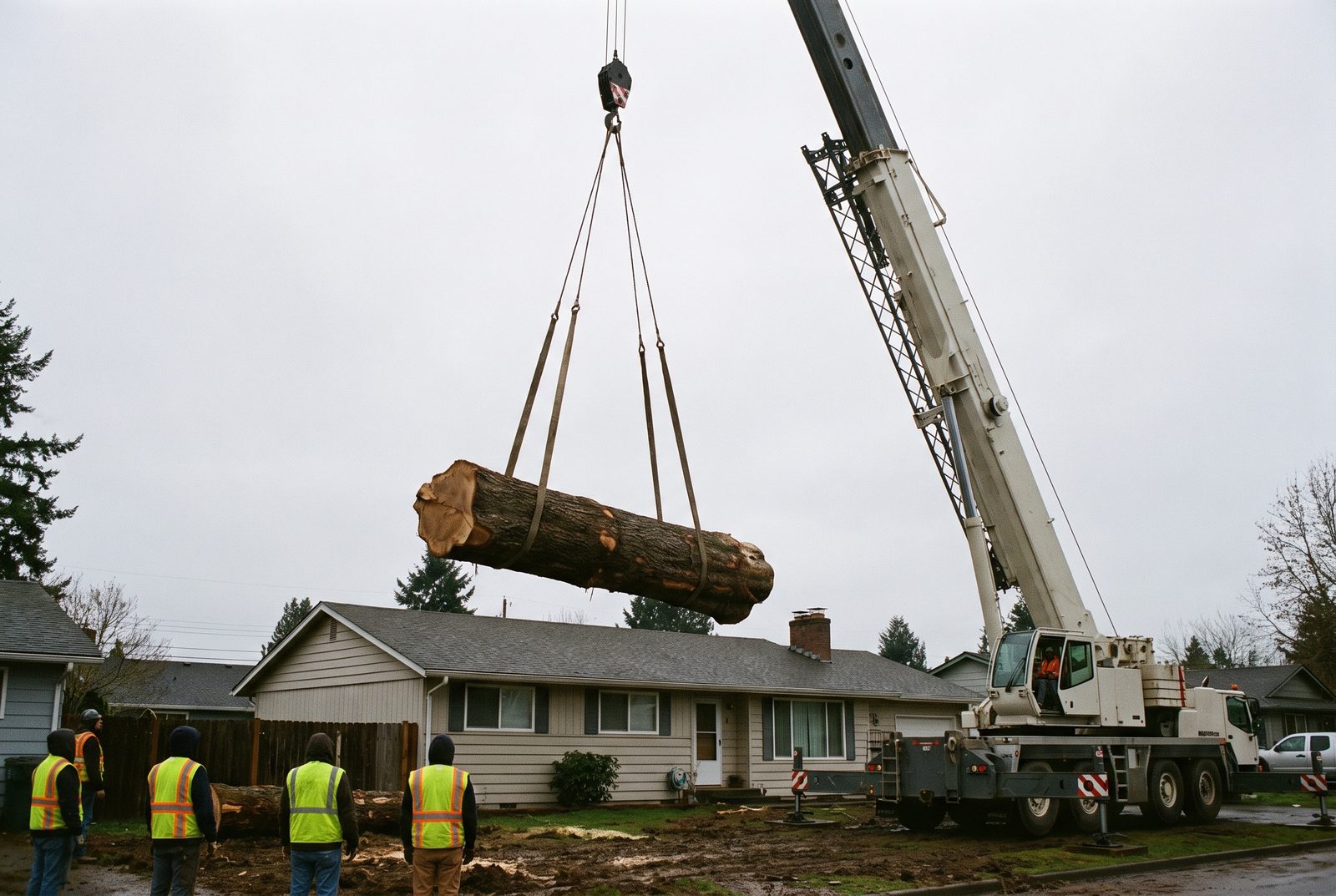
Where removal genuinely is the answer, method matters. On a tight lot with a house, fence, driveway and neighbouring property in the target zone, controlled rigging or crane extraction is not an upsell. It is the difference between a routine job and a claim.
This report is general information about residential tree risk and is not a substitute for an on-site assessment of your specific property by a qualified arborist. Conditions vary enormously by species, age, soil, climate and site.
A certified arborist will come out, assess the tree properly and tell you plainly what — if anything — it needs. Fully insured, and there is no cost or obligation for the visit.
A certified local arborist will be in touch shortly — usually within minutes during business hours. If you marked this urgent, expect a call first.